Consistency Compounds Excellence: The Research-Backed Case for Reliable Performance
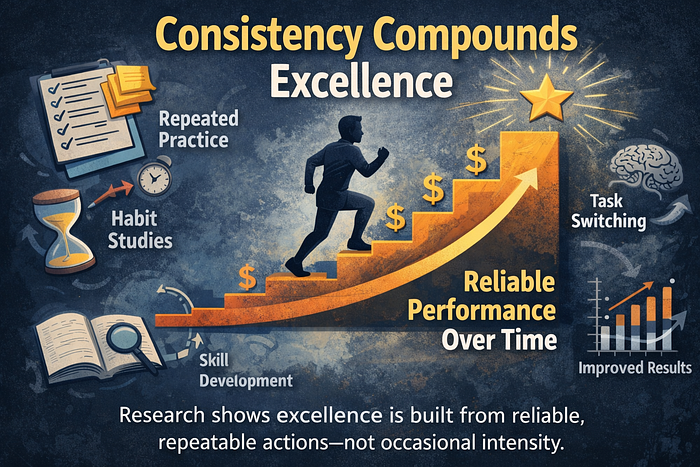
“Excellence” is often marketed as intensity: the all-nighter, the heroic grind, the sudden burst of motivation that changes everything. But in real life — especially in online business — excellence is far more predictable (and far less dramatic).
It’s the product of reliable performance over time: small actions repeated long enough to become skill, trust, and results.
That claim isn’t just motivational. It’s strongly supported by research across habit formation, goal achievement, deliberate practice, and cognitive performance.
Why occasional intensity fails (even when it feels productive)
Occasional intensity creates a psychological illusion: because you did a lot today, you assume you’re “on track.” But long gaps between efforts reset momentum, increase friction, and push you back into the hardest part of any behavior change: restarting.
Consistency works differently. It reduces the “start cost” by making action routine, not heroic. It also creates a steady stream of feedback — what worked, what didn’t, and what to improve — so your efforts compound instead of repeating the same mistakes.
Jim Rohn summarized the principle well: “Success is nothing more than a few simple disciplines, practiced every day.” The science agrees.
1) Habit research: repetition turns effort into automaticity
A widely cited study by Phillippa Lally and colleagues tracked people building real-world habits and found habit automaticity grows gradually over time, following an “asymptote” pattern — big gains early, smaller gains later. Importantly, it highlights that habit formation often takes weeks to months, not days.
Why that matters: if you expect excellence to appear quickly, you’ll interpret the early phase (when it still feels hard) as evidence you’re “not disciplined.” But the research suggests the opposite: the early phase is inherently effortful — and that’s normal.
Behavior change implication: Don’t judge consistency by how you feel. Judge it by whether you showed up.
2) Implementation intentions: “If–then” plans measurably increase follow-through
One of the most practical research findings for building consistent performance is implementation intentions — simple “if–then” plans that pre-decide your behavior.
A meta-analysis by Gollwitzer & Sheeran found implementation intentions produced a medium-to-large effect (d ≈ .65) on goal attainment across many studies.
Example:
- • “If it’s 9:00 a.m., then I write 200 words.”
- • “If I open my laptop, then I publish one piece of content.”
- • “If I feel resistance, then I do 5 minutes anyway.”
Behavior change implication: Consistency improves when decisions are made in advance — not negotiated in the moment.
3) Goal-setting research: specific goals outperform vague effort
Reliable performance strengthens when your target is clear. In their review of goal-setting research, Locke & Latham report that specific, difficult goals reliably outperform “do your best” goals, with meta-analytic effect sizes reported in the .42 to .80 range.
This supports a key idea: consistency isn’t just “work hard.” It’s “do the right work repeatedly.”
Behavior change implication: Define what “consistent” means in measurable terms (e.g., “publish 5 posts/week,” “send 3 emails/week,” “test 2 headlines/day”).
4) Deliberate practice: excellence comes from structured repetition, not random effort
Consistency alone isn’t enough if you repeat the same errors. Excellence compounds fastest when repetition includes deliberate practice — targeted activities designed to improve performance.
A major meta-analysis (Macnamara, Hambrick, & Oswald) found deliberate practice explains a meaningful portion of performance variance, especially in domains like games and music (e.g., ~26% for games, ~21% for music), though less in professional performance overall.
Takeaway: practice matters — especially when it’s structured, feedback-driven, and progressive.
Behavior change implication: Consistent action + consistent improvement beats consistent effort with no feedback loop.
5) Cognitive research: switching tasks quietly destroys “reliable performance”
If excellence requires reliable output, then attention is a resource you must protect. Research on task switching shows that alternating tasks produces measurable “switch costs” that increase with complexity.
Interruptions add another tax. Gloria Mark and colleagues found people compensate for interruptions by working faster, but at a psychological cost — higher stress, frustration, time pressure, and effort.
Behavior change implication: Reliability increases when your environment supports focus (fewer switches, fewer interruptions, fewer decisions).
The compounding model: how consistency becomes “excellence”
Think of excellence as compounding in four layers:
- Reps → you show up reliably
- Feedback → you see what works
- Refinement → you adjust and improve
- Reputation → trust forms because you’re consistent
In online business, people trust what they can predict. Consistent posting builds familiarity. Consistent follow-up builds reliability. Consistent quality builds authority. And authority compounds into opportunity.
A practical system to build reliable performance (without burnout)
If you want to change behavior, make consistency small enough to sustain, and structured enough to improve.
The “Minimum Viable Consistency” plan
Pick one “non-negotiable” daily action:
- • 20 minutes of content creation
- • 10 outreach messages
- • 1 email draft
- • 1 small test (headline, offer angle, hook)
Make it too small to skip.
Add one “if–then” trigger
- • “If it’s after coffee, then I write.”
- • “If I feel resistance, then 5 minutes.”
(That’s implementation intentions in action.)
Protect one focus block
- • one 45–90 minute block with notifications off
- • one tab open
- • one task
(Task switching costs are real.)
Make improvement visible
Use one metric that reflects consistent effort:
- • posts/week
- • emails/week
- • tests/week
- • outreach/week
- • content minutes/day
The motivational truth: you don’t rise to intensity — you fall to systems
Intensity is useful occasionally. But it’s unreliable as a strategy.
Consistency is different: it makes excellence repeatable.
If your current pattern is “bursts and breaks,” the next step isn’t self-criticism — it’s redesign:
- • smaller targets
- • clearer triggers
- • fewer distractions
- • more feedback
- • steady repetition
That is how behavior changes. And it’s how excellence stops being an accident and becomes the natural result of how you operate.
Question to leave with: What could you become excellent at if you did the smallest useful action — every day — for the next 90 days?
Special Offer Read Now!
Click the Link to Get A Free Funnel System That Generates LEADS & Sends 30 Daily Emails That Promotes Your Primary Business Automatically!